

Millennium Project
This talk was originally given to the Deddington & District History Society by Chris sometime in the 1980s. The images titled in bold in the text were originally shown as clear acetate sheets projected on to a screen using an old technology overhead projector. Some colour and detail has inevitably been lost in scanning and turning them into pdfs. (click on blue links to view them)
Castles and castle sites have, quite rightly, been the focus of attention for archaeologists, for military and architectural historians, and for those interested in the high politics of an age. It has to be admitted, the smaller the castle, the less intense the interest, but even a Deddington (after all, the sort of site that is most common in this region) merits close attention. On this occasion I thought it would be interesting to try also to see what could be said about the role played by a small castle in the life of its local community across the whole of its existence.
In what follows I shall say something about those who built, fortified, and lived in Deddington castle. I shall also say something about those who profited from it when it had ceased to be inhabited. What was the site used for? Who had access to it? I shall try to trace how the castle and its owners have influenced Deddington's development, topographically, economically and socially. Finally, I shall briefly outline the castle's shift from stronghold through private estate to public amenity. Much of what I say, though peculiar to Deddington, should have a much wider application.
The archaeology
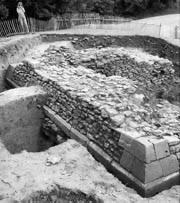
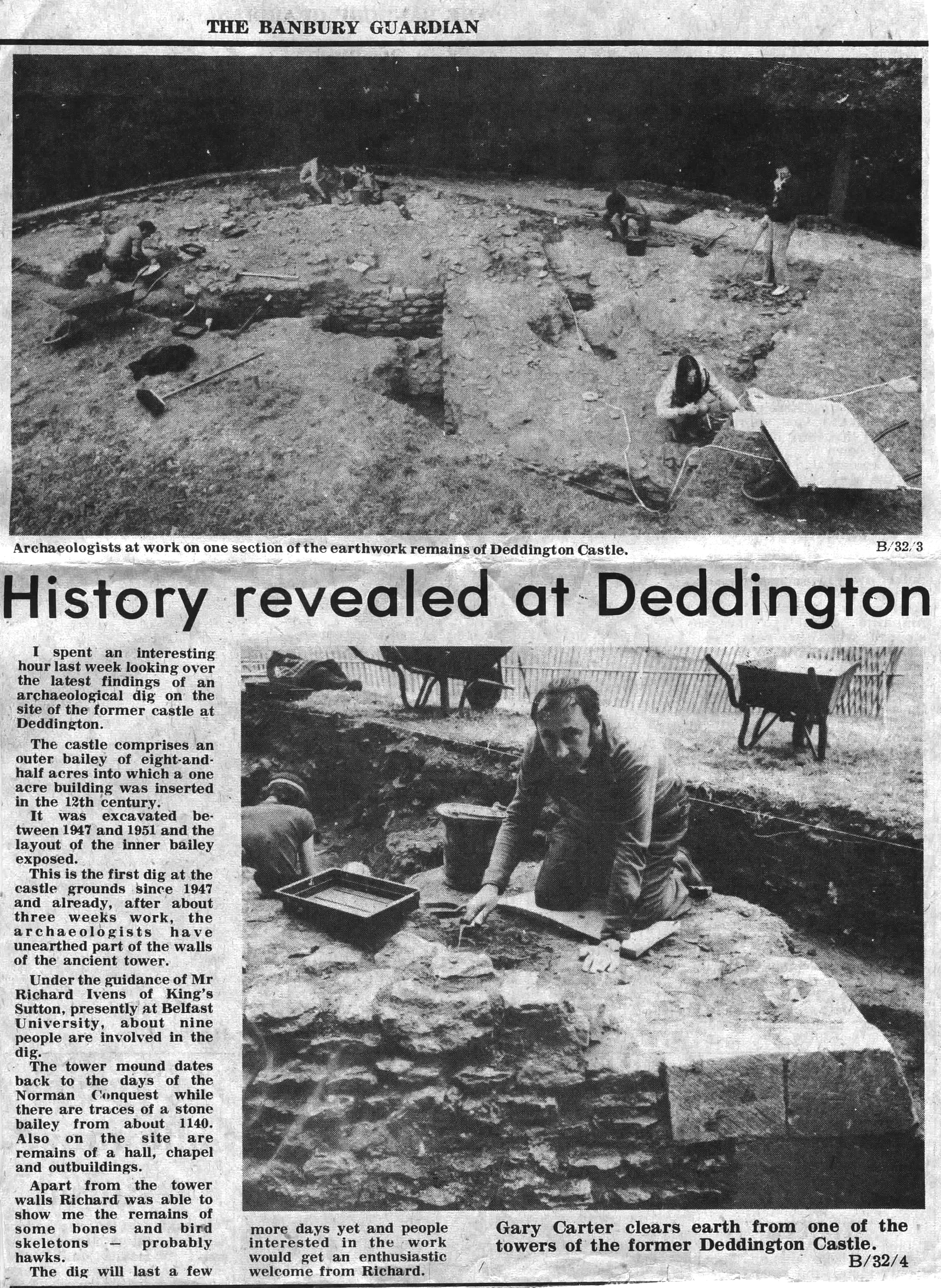
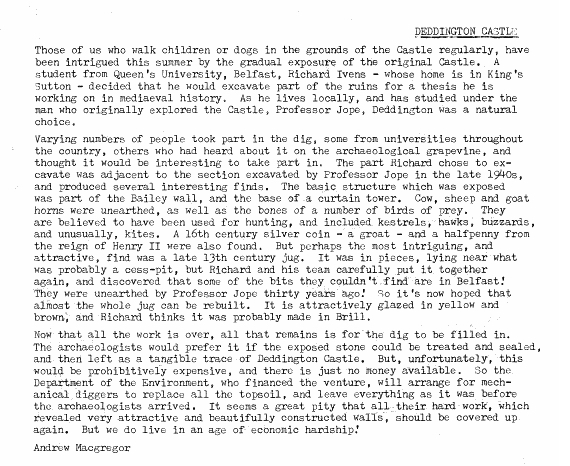
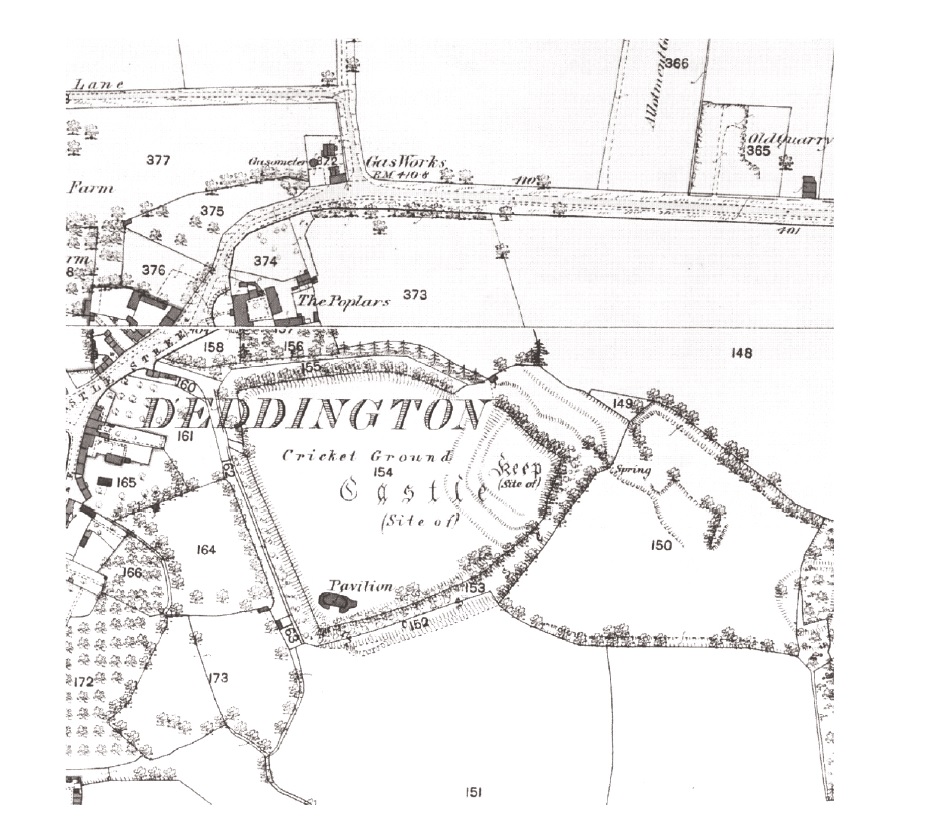
[1. Historic town plan of Deddington] This will be a brief summary. First excavations= rescue excavations by Prof. Martin Jope between 1947 and 1951. Further excavations were carried out by Richard Ivens 1977-9.
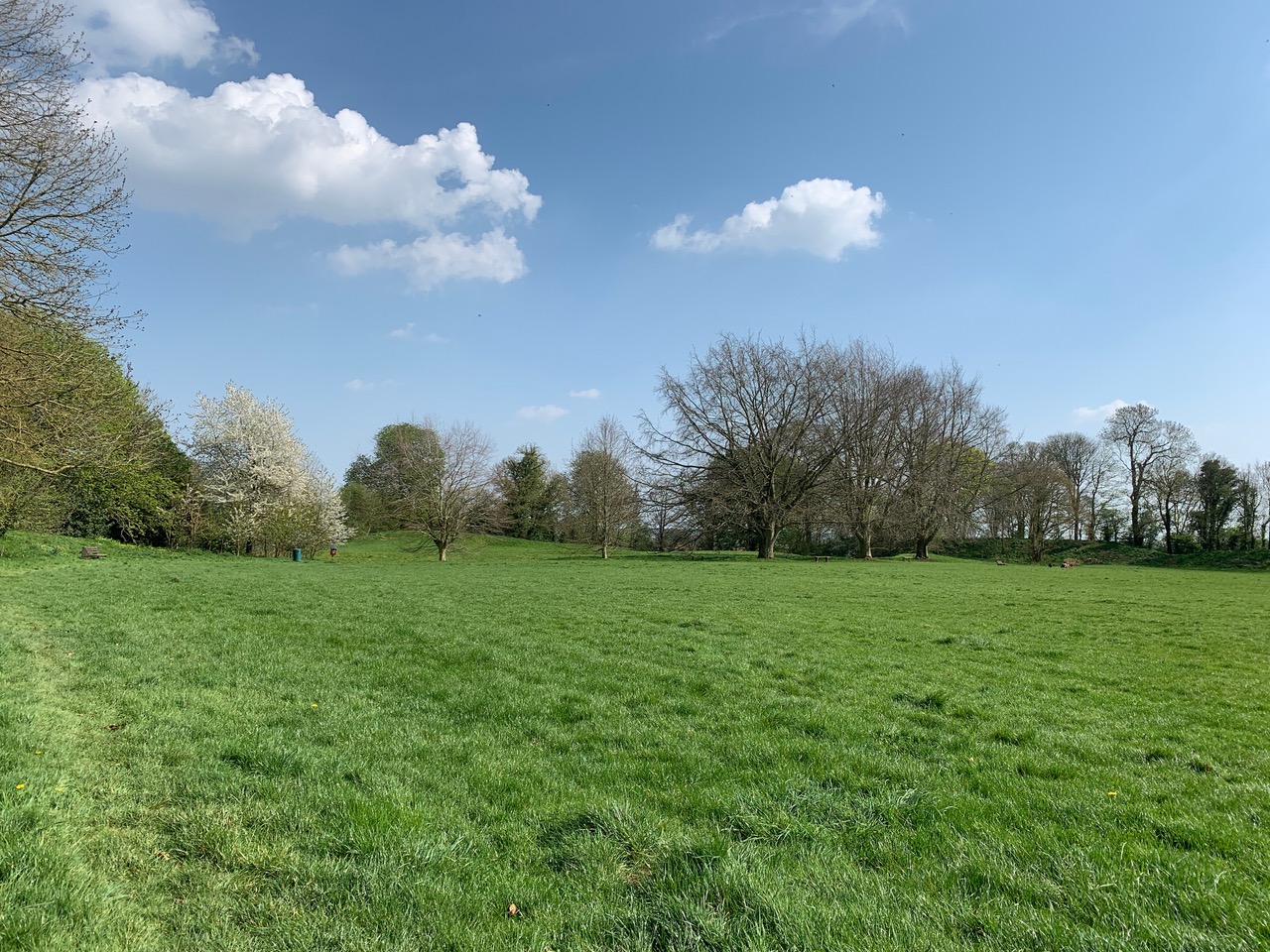
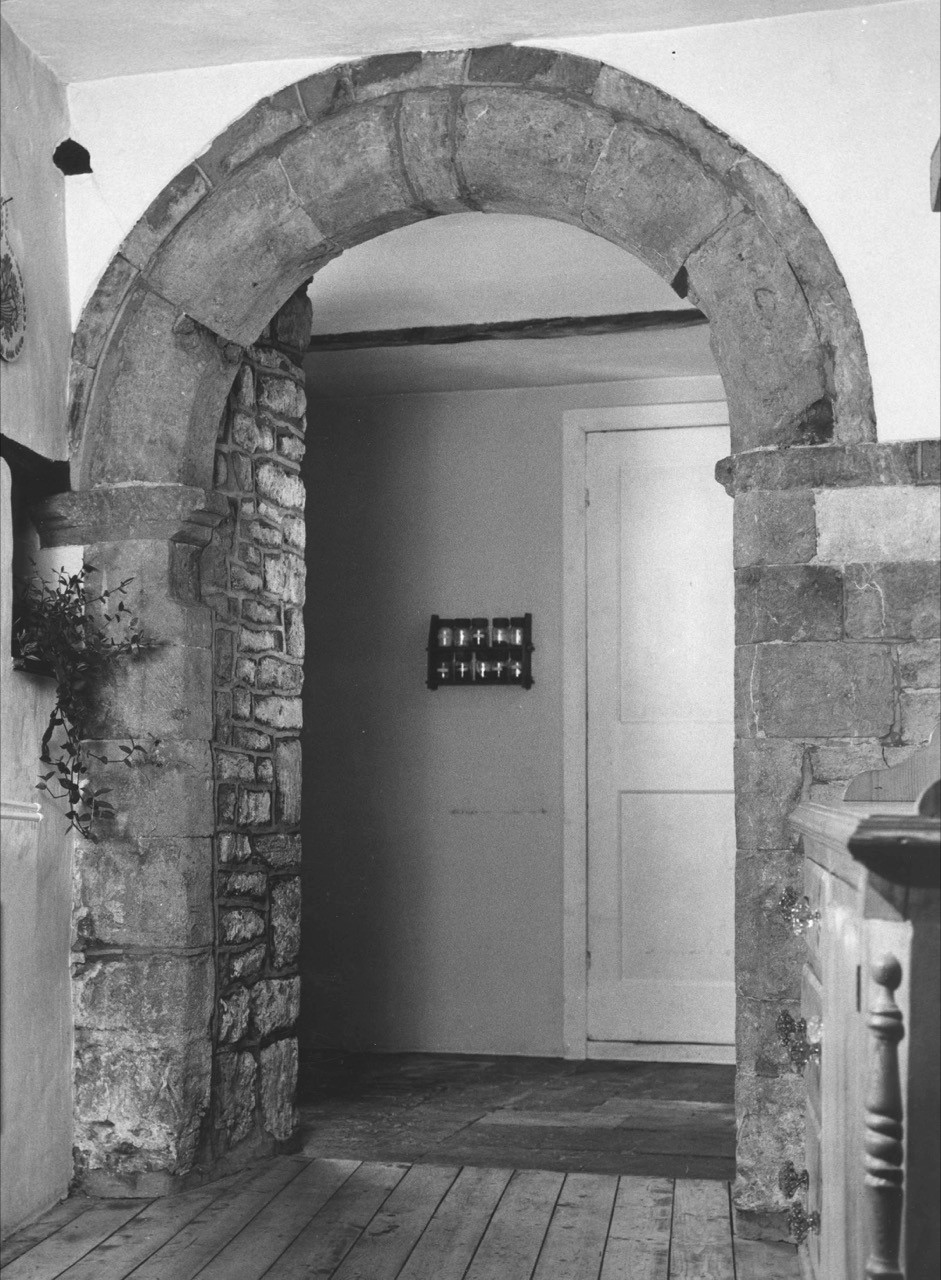
The entire site comprises 3.4 hectares (8.4 acres). The inner bailey at the east end, where the excavations took place, comprises almost a half-hectare (just under an acre). The excavations of the inner bailey uncovered late Saxon artefacts and the remains of a late Saxon stone building. Saxon pottery has been found in the outer bailey. There was, therefore, late Saxon occupation of the site before the castle was built. It was presumably the home of the Saxon lords who owned Deddington before Conquest. Was it earlier an Iron-Age hill fort [2. Football field: 3. Earthworks]
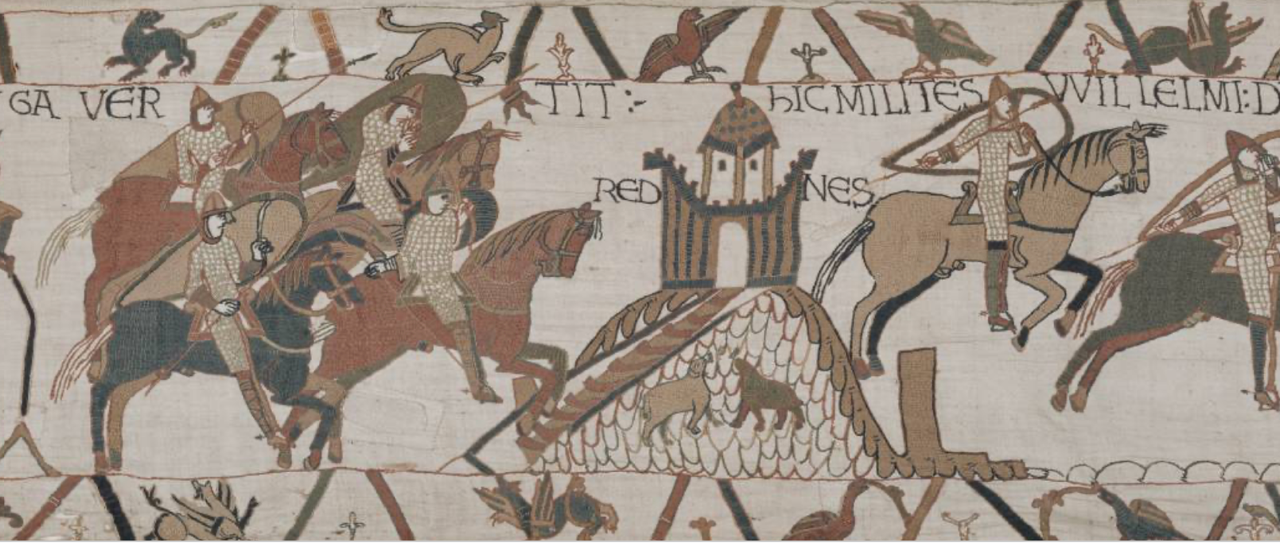
Deddington was granted after the Conquest to the Conqueror's half-brother, Odo of Bayeux, warrior bishop and tapestry commissioner. Deddington was one of 400 manors granted to this most powerful of men. But, though only one of 400, it was important. His Deddington estate was one of the richest manors in Oxfordshire, worth twice as much as Banbury. Soon after the Conquest he built a castle at Deddington. It was a typical Norman motte and bailey type of castle. [ 4. Ascot D'Oyley Castle: 5. Deddington Castle Motte]
Deddington castle in the Middle Ages
It is unlikely that Odo ever came here. He was deprived of his estates for rebellion in 1088. As Howard Colvin laconically observes in his History of Deddington, 'What reputation he left in Deddington can only be surmised, but if (as the archaeological evidence suggests) it was he who ordered the making of the castle, it is likely to have been that of an alien and absentee lord whose rights could be maintained if necessary by military force and whose hand lay heavily on the Oxfordshire landscape.' (p.19) We do not know what happened to Deddington after Odo's fall, and it may have been retained in the king's hands.
In approximately 1100 an inner bailey was
created (fig. III on plan of excavations):
[ 6. Deddington Castle, structural periods I-V] By the mid 12th century Deddington was in the hands of William de Chesney, King
Stephen's military governor of Oxford during the civil war between Stephen and Matilda that devastated the country from 1138
to 1153. It was
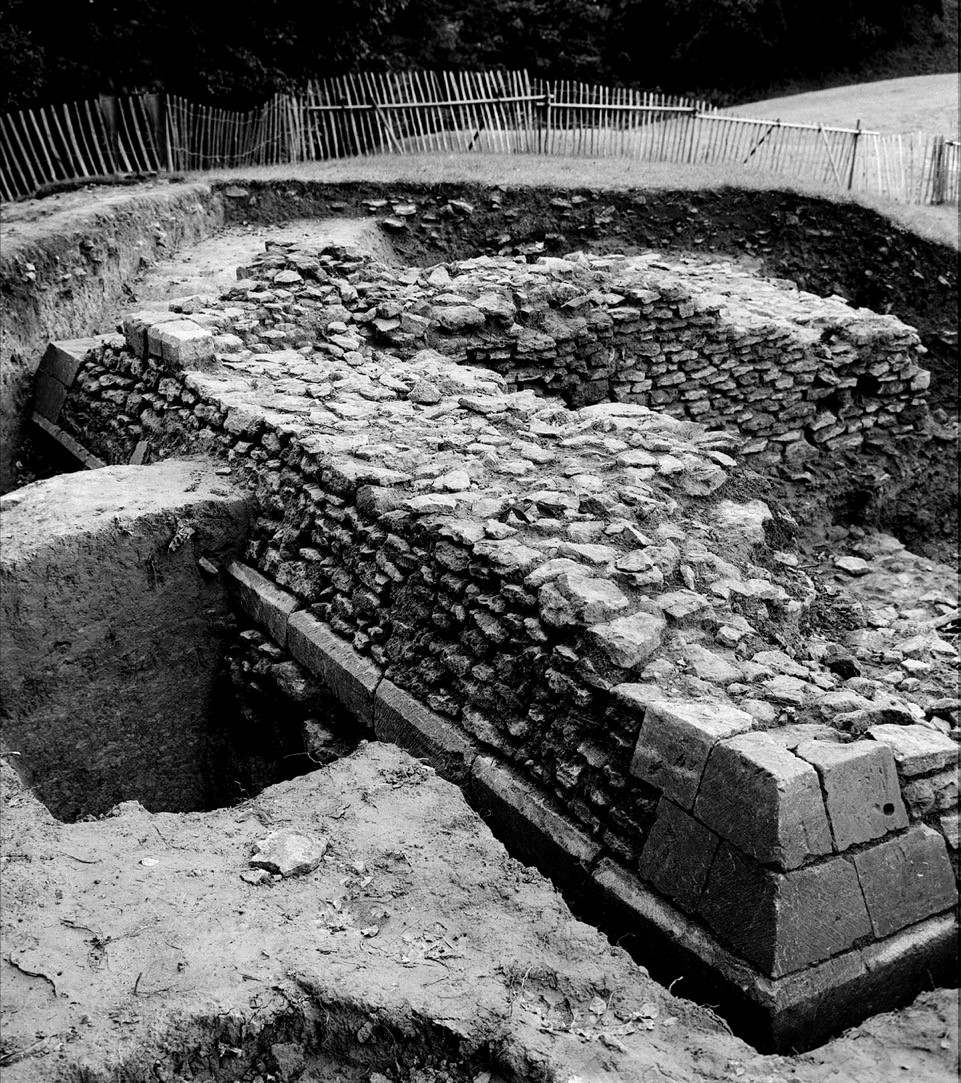
probably William who built the first stone defences, including an ironstone
rubble wall 2m. thick. (Fig. IV) The castle seems to have played no direct part in the civil war. Deddington castle was presumably
garrisoned and used as a supply base, but military action, when it came, was
not here but near Oxford where, in 1153, William was defeated by Matilda's son
Henry of Anjou, later King Henry II.
In the post-war settlement, the Chesneys were allowed to retain some of their lands, including Deddington. Inheritance to the estates was later disputed, with the result that in 1190 Deddington was divided into three manors, a division that more or less persisted thereafter and that had long-lasting implications for the place. This was an age of great political uncertainty and of shifting allegiances in which, as has been observed, 'the courtier of one reign might become the outlaw of the next'. (Colvin, p. 22) Thus, the Castle manor had passed into the hands of the de Dive family, related to the Chesneys by marriage. The Dives were strong supporters of Richard the Lionheart against his troublesome brother Prince John. The Dives' right of ownership was disputed by the Murdac family, which had enjoyed the favour of Henry II but not that of Richard - a good example of the shifting fortunes to which I referred a moment ago. In an attempt to restore their fortunes Ralph Murdac supported John when he rebelled against his brother the king in 1194. Had John's rebellion succeeded the Murdacs would have ousted the Dives. As it was, Ralph forfeited his estates. He compounded his error of political judgement by dying in 1198, before his patron John came to the throne. When, therefore, Ralph's rival Guy de Dive fell from favour on John's accession in 1199, Ralph was revolving frustratedly in his grave.
Guy's lands were returned to him in 1204, except, that is, for Deddington castle, which, in the words of the royal grant, 'we wish to keep in our own hands' . In other words, the castle was of a strength that made its custody a matter of royal concern. At its fullest extent, the castle seems to have included a chapel, hall, solar, and several service buildings. [7.Composite plan: 8. Information board] Not surprisingly, the king was reluctant to relinquish the castle until he could be sure of Dive's loyalty. That took another year and, no doubt, a substantial sweetener to the ever-needful royal treasury.
Guy died in 1214, leaving behind an under-age heir: another financial opportunity for the Crown. King John exercised his feudal prerogative by marrying Guy's widow to Robert de Harcourt (of Stanton Harcourt) and by taking the castle back into his own hands, entrusting it to his old supporters and rivals of the Dives, the Murdac family.
We must cut a long and sporadically interesting story short. Suffice it to say that despite prolonged litigation after John's death in 1216 none of the feuding families succeeded in making good its claim to another's estates, and the three manors descended separately. The manor with which we are concerned was that of the Dive family, known, unsurprisingly, as the Castle manor. It is interesting to note that the castle was still significant enough, in status if not in military substance, for successive lords of the manor to describe themselves as 'lord of Deddington castle'.
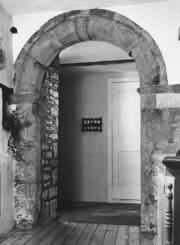
There seems to have been something about the lordship of Deddington castle that clouded political judgement. William de Breaute, who had possession during a minority in the Dive family in the early 13th century, died in rebellion against the Crown. John de Dive took up arms in support of Simon de Montfort against Henry III and was killed at the battle of Evesham in 1265. The Dives forfeited their lands but were allowed to recover them on payment of a substantial fine. Thereafter, the family seems to have kept its collective head down, but on its shoulders at least. They left the exciting life to the lords of the other Deddington manors such as Osbert Giffard, who in 1284 abducted a possibly not unwilling nun of Wilton and took her overseas, 'to the peril of her soul and the scandal of many'. Castle House stands immediately north of the church. [9. Castle House] Castle House was the rectory, and it is so called because it was usually leased with the Castle estate.
The castle was, as I have said, in a state of decay.At this point I will just round off what we know of its disappearance as a physical stronghold. It was described in 1277 as 'an old demolished castle'. Enough remained, however, to be the focus of the only recorded warlike incident in its history when in 1281 Robert of Aston and his associates broke down the gates and doors. It is impossible to be certain, but I suspect that the Aston in question here is North Aston. It may be significant that an earlier Robert of Aston, mentioned in the early to mid 13th century, was the husband of an Alice Chesney. The attack may have been yet another episode in the family dispute over the lordship of Deddington. In 1310 the castle was described as 'debile', meaning weak, diminished, or worn out. It nevertheless retained a chamber and a dovecot, the chamber perhaps lodged in by a keeper. The archaeological evidence confirms that there had been no new building during the 13th century.
In 1377 the canons of Bicester Priory were given permission (for a price: 5 marks) to enter the castle and cart away 'omnes lapidos vocatos hewedstones murorum', i.e. the dressed stone from the walls. After which the rubble infill would soon disappear. It is tempting to subscribe to a doctrine of reincarnation (or reinlapidation, or whatever) when trying to explain where substantial historic buildings have disappeared to. According to that doctrine, Deddington castle is still here - no longer a castle but enjoying a new existence as houses and barns. Sadly, that seems unlikely. I am sure that a certain amount of material must have been 'liberated', but dressed stone, timber, and roofing materials were valuable commodities. The castle's owners would have taken good care to protect their investment. I suppose that if you really want to rediscover the stones of Deddington castle, you should go to Bicester.
The archives of St George's Chapel, Windsor, which acquired the castle in 1364, contain many references in the 15th and 16th centuries to repairs at Castle House, the rectory, but none to buildings at the castle. When the antiquarian John Leland visited Deddington in the early 16th century, he noted merely that 'there hath been a castle at Deddington'. Leland was travelling the country collecting towards what would have been, had he completed it, a mammoth history and gazetteer. Sadly, before he could complete it, as a contemporary noted, 'he fell beside his wits' - a warning to us all!
There may have been nothing above ground worthy of Leland's notice, but plenty remained below. It was noted in 1819 that people were digging for building materials at the east end of the site. Gardner's Oxfordshire Directory of 1852 recorded that about ten years previously the keep had been excavated for materials. Even despite those, and possibly other, depredations, there remained stonework for 20th-century archaeologists to uncover.
The castle and urban development
[10. 1808 plan of Deddington, showing relationship of castle site to town] At this point I would like to return to an earlier period in order to discuss the role, if any, of the castle in Deddington's development as an urban centre. Deddington was one of many new towns established in England and Wales in the late 12th and 13th centuries. We have no documentary evidence such as a charter that relates specifically to the setting up of the borough, with a nice convenient date. Instead, we have to read between the lines of other documents. If only one of the three manors in Deddington possessed burgage plots (the basic tenements in a town), we could assume that they were established after 1190, when the manor was divided into three. The fact that burgages are to be found on all three manors therefore argues that they were created before 1190. We are probably safe to place the borough's creation in the late 12th century.
This subject needs a whole lecture to itself, but given our theme it is necessary to consider briefly what role the castle, or rather its owners the Chesneys, might have played. It was fairly common in the Anglo-Norman period for the creation of boroughs to be associated with castles, or with abbeys, and since Deddington had a castle it might seem at first sight to be such a case. But the close association of borough foundations with castles was less common in southern England than elsewhere - notably, of course, in Wales. Moreover, a glance at the map tells us that Deddington castle and the market place have no apparent relationship - topographically, at least.
Despite political instability in the late 12th century, the borough of Deddington was not planned with defence in mind. A new town did not need to be placed in the defensive lee of a castle in the manner, most famously, of Durham, with which illustrious city Deddington shares only an initial capital letter. Deddington was a commercial development, taking advantage of its position at the junction of important through routes. The market place and burgage plots were laid out in relation to those routes rather than to the castle, which was less convenient for such a purpose. You might say that here the market place replaced the castle gate as the focus of the community. In other towns (and Windsor is a convenient analogy here) the castle dominated the town. Not here. The unobservant traveller in the market place might not know that there was a castle here at all.
You might think that, nevertheless, the town was set up to supply the needs of the great family and its retainers living at the castle. That is very unlikely.
Such households tended to get their supplies from their own estates, while luxury goods would be imported directly or bought at major regional markets like Oxford. There would undoubtedly be a demand for goods and services that would provide some stimulus. Deddington, however, fits better into that category of small borough that made its living providing goods and services not to a great household but to a rapidly expanding rural economy, supplying woollen and linen cloth, leather goods, iron goods, fish and salt. Only the annual fairs would attract more specialised traders travelling long distances.
I have used the phrase 'set up', and one commonly finds references to new towns being 'planted'. Such expressions probably over-emphasise the extent to which urban centres were simply imposed where none had existed before. It seems more likely that what we think of as new towns represented, rather, attempts by lords to control and profit from commerce that was developing anyway. Deddington in the late 12th century was a composite place, combining rural and urban functions. When one of the Chesney family, presumably, laid out the market place and burgage plots he was, I would suggest, taking advantage of rather than creating trade.
What was in it for the lord? Well, it doesn't take a genius to answer that one. A new town was a speculation, and if it was successful it could be highly profitable to its owner. He got rents from burgage plots and market stalls, and he received tolls from traders coming in from outside. He also profited from control of weights and measures, and he received the fines imposed on offenders. Later on, he got additional fines and rents by allowing building encroachment in the market place. Such encroachments are seen in most market towns, and we have good examples in Deddington. They are usually regarded as originating in temporary market stalls that later became illegally permanent. It seems, though, that market owners often encouraged such buildings (albeit to the dismay of townspeople who would be inconvenienced by them) in return for additional rents.
What about the townspeople? They were in a privileged position. They got a tenement for a straight money rent, free of the burdensome and sometimes humiliating services owed by tenants of agricultural holdings. What is more, town tenements were freely transferable, offering a possible source of profit or of making provision for one's children. The initial tenant of a burgage plot always had the opportunity, if the town was successful, of subdividing his plot, perhaps covering his entire rent from what he charged his own sub-tenant. Many medieval burgesses, especially in a small place like Deddington, were also farmers. They therefore had good opportunities to make a profitable living, and they had a hedge against bad times. It is a false dichotomy to see a place as either rural or urban. It could be, as Deddington was, both.
St George's Chapel, Windsor
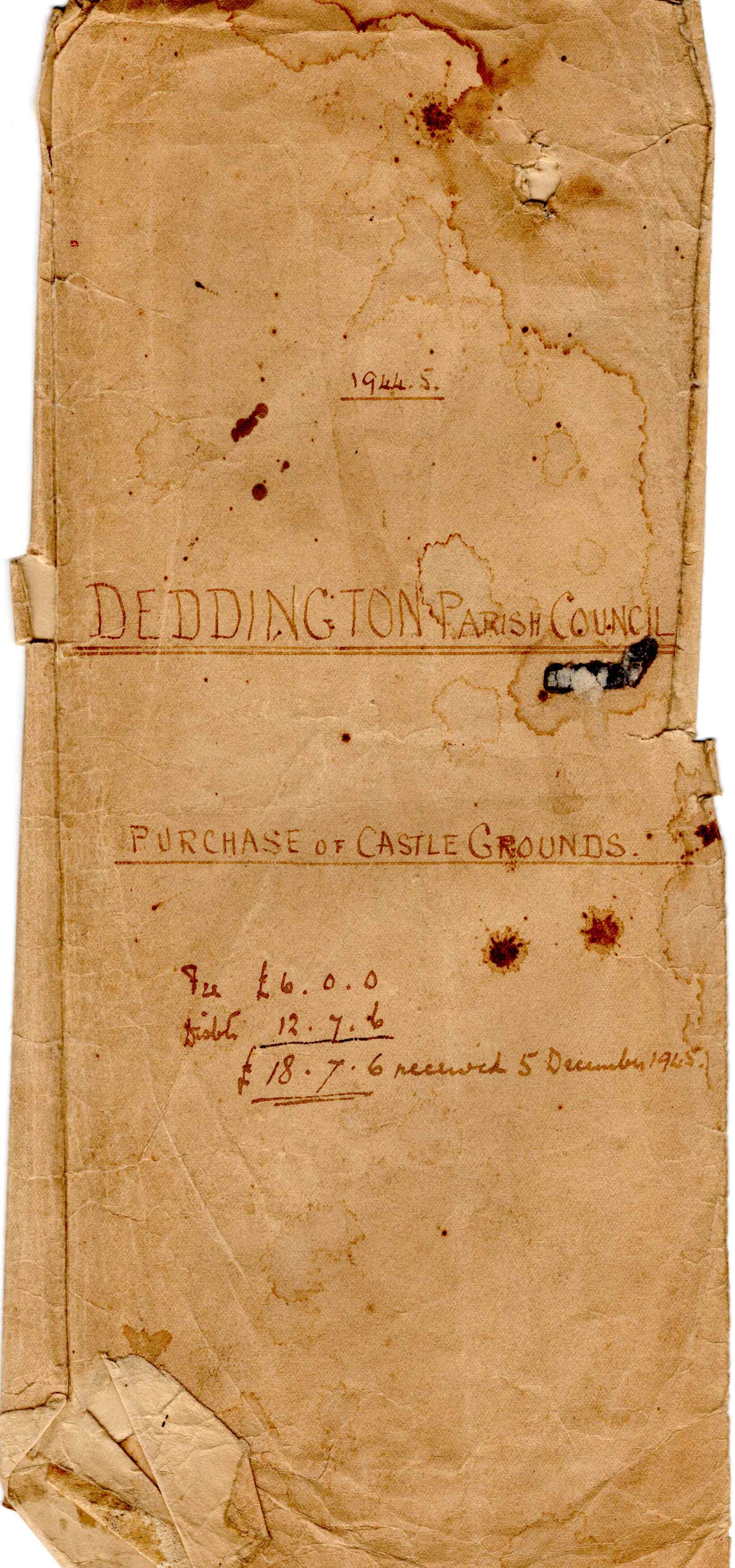
The Dive family's long association with Deddington came to an end in 1364 when they sold their estate to the Warden and canons of St George's Chapel, newly founded by Edward III in Windsor Castle. The canons held it for 500 years until in 1866 the title passed to the Ecclesiastical Commissioners. The Ecclesiastical Commissioners sold the site to Deddington parish council in 1945.
Under the canons' ownership, the castle site embarked on a new chapter, if you will pardon the excruciating pun. Instead of being the decaying stronghold of a declining knightly family, intermittently involved with national politics and warfare, it became part of what in modern parlance we might call the property portfolio of a leading institutional body. The canons already owned the rectory estate at Deddington, and the castle with its associated land and houses was a logical purchase. [In the 1460s or 1470s the canons added to their portfolio an ancient freehold estate of 80-l00a. called the Leadenporch, whose name derives from the house of that name still standing in New Street.]
The estate directly associated with the castle is described in a rental of 1557. It divided the estate in two. One, described as 'the castle and park', was an enclosed area comprising the castle and grounds, and including a pond, a fishery and a warren; the other part comprised 12a. pasture and 30a. meadow that contained a 'gurgite', meaning a weir. That fish weir, as it is elsewhere called, lay in the area still known as The Fishers. [11. Fishers Pond - Fishers field and pond are SE of the Castle Grounds - No.150 on this map ]
The canons' insistence that their tenants regularly scour the ditches is one reason why they remain so impressive today.
To the canons of St George's, all these things were an investment that was expected to show a return. We have already seen that easily transported materials (the 'hewed stones') had soon been on their way to Bicester. In 1393 Richard II granted the canons the right to hold two annual fairs, each of three days' duration, starting on 15 July and 11 November. Intriguingly, the grant refers to the fairs as being held at the castle. If so, that would be an early and possibly short-lived opening up of the grounds to the public, albeit for the profit of the canons. Later fairs were held in the market place.
The canons preferred to lease the estate rather than run it themselves. That can be frustrating for the historian, because very often all we find is the record of a money payment, with little indication of what the tenant was actually doing. There is enough evidence, however, to make clear the importance of the grounds for pasture and for timber. Fortunately, the canons took a particularly keen interest in their timber, a slow-growing crop that a careless or greedy tenant could easily ruin. Tenants were occasionally visited and required to account for missing trees, as when in the reign of Henry VIII John Rogers was grilled about nine trees, 'the best in the lordship', worth 53s.4d.
The importance of the timber is demonstrated in a small notebook of the late 18th century recording the number and height of each species growing in the 'castle yard'. [C12. Castle Yard] Ash trees (231) were the most numerous, followed by elms (156), oaks (103), sycamores (66), and poplars (55). That is a startling number, and though you will see plenty of trees as you walk around the grounds you won't see anything like that number. You won't see English elm, or poplar; the stump of a single oak remains. There are plenty of ash, and horse chestnuts that were planted in the 19th century. What struck me about the trees listed in the notebook was how short most of them were, many less than 3' high. What that means, of course, is that they were planting saplings densely, thinning them out later. It certainly suggests careful management rather than a site abandoned and left to grow over.
The modern history of the castle site
I have chosen to concentrate the final section of my talk on what I see as the gradual opening up of the site to the public. In the early 19th century it was a place that could be visited, though it was not permanently available for public recreation. In 1836 the vicar recorded in his diary that 'I went into the castle grounds to see their cold bath'. I would dearly like to know what and where that cold bath was. One might almost imagine him to have been in Rousham gardens. For events, special permission was needed. It was usually granted, if the cause was deemed worthy.
The gradual opening up of the grounds to the public illuminates aspects of changing patterns of social, especially sporting, life so characteristic of the period. Trade directories, newspapers and diaries reveal a growing range of activities being accommodated at the castle grounds in the 19th century. A horticultural society was established in 1838, its annual show housed in a marquee at the castle grounds, where the gentry presented prizes to cottagers. Cricket was being played there by 1840. The Deddington Rifle Corps, formed in 1860, carried out perhaps the first military parades at the castle for 700 years. An amusing anecdote that I cannot resist relates to the Rifle Corps. [W13. Wilkins's view] Mary Vane Turner, whose invaluable little history of Deddington was published in 1933 and recently reprinted by the Deddington History Society, pointed out that Joseph Wilkins's bird's-eye view of Deddington, made c.1865, contains a local joke: when looking closely at the original, one can see the volunteers 'drawn up by the town hall, while away far off in St Thomas's Street is their drummer, beating the big drum, quite alone'. The joke is given added point if you know that the errant drummer was John Knibbs, town crier and ale taster to the manor court. [14. John Knibbs]
The general point I want to make in relation to the activities hosted at the castle grounds is that they were primarily for the better off. [15. OS Map enlargement showing cricket ground and pavilion] The cricket club, later expanded to include archery, was hardly inclusive, as its title of Gentlemen's Cricket Club made clear. Indeed, the club employed a professional cricketer and groundsman who lived at the castle grounds lodge. [16. Lodge] The point was reinforced by the first building of any size to be erected there since the Middle Ages. [17. The Pavilion] In the mid 19th century a large pavilion was built in the south-west corner of what had been the outer bailey. According to Mary Vane Turner, it was 'so large that it contained a spacious ballroom with musicians' gallery, cloakrooms and a refreshment room. The whole was covered with an immense roof of thatch. Inside the ballroom walls were hung with glistening chintz in a floral design and at intervals gas jets were arranged around in star-like clusters. Dance music was provided by a band from Oxford, invariably including a harp. The society gatherings there were brilliant and exclusively 'County'. Deddington could have no share in those functions except such satisfaction as might be obtained from gazing upon the smart equipages which went towards the entrance gate full, returning empty to park in the market place.' (c.f. Ch 8 of Mary VT's book/Pavilion)
The Revd Cotton Risley recorded in his diary for 1 August 1863 the celebrations at the castle grounds for the anniversary of the Deddington Reading Room. A game of cricket was played at 11.00 - apparently behind closed gates. The grounds were only opened to the public at 2.00. Tea and cake were served in the marquee. A band played. Children played games. Risley records who was there: 'we noticed on the ground and at the tea tables the Revd W.C. Risley and Mrs Risley...', and there follows a list of the great and the good of the neighbourhood. Either no-one else was there or, more likely, they were not worth noticing.
In much of this the goings-on at the castle grounds were, of course, the world writ small. Organised sport in this period had, under the influence of the public schools, been taken up with enthusiasm by the middle classes. As everyone knows, organised games with their carefully drawn up rules 'became an analogy for middle-class life: a competitive struggle within agreed parameters'. (Hugh Cunningham, 'Leisure and Culture', in ed. F.M.L. Thompson, Cambridge Social Hist. Of Britain, 1750-1950, ii. 297) Rural labourers might be admitted and even encouraged to join in, once the middle classes realised that sport could be equated with virtue and leisure activities used for improvement. In Deddington, as elsewhere, one can observe this evangelical and teetotal ethos of improvement in a plethora of voluntary associations: the Reading Room and Lending Library in 1858, a Penny Bank in 1859, a Sunday School Shoe Club in 1861, a Choral Society in 1862, a coffee tavern (short-lived, I'm afraid) in 1881, and so on. As Howard Colvin has noted, Deddington in the reign of Victoria was transformed 'from the town where the people proverbially 'sold the bells to buy gin' into as sober and self-respecting a community as any in Oxfordshire'. (p. 79)
Many Deddingtonians, however, lacked the time for leisure activities or the money to pay for them. In sport, specifically, the formation of a football club in 1886 may be seen as heralding a change. The club played its matches at the castle grounds, and it is perhaps not too fanciful to see this as the start of opening up the site to the whole parish. In 1911 the P.O. Directory announced that the castle grounds are 'used as a parochial recreation ground, managed by a syndicate.' In 1912 a rifle club was set up, using the outer bailey for a firing range, firing into the embankment. So, if you find a bullet embedded in the earthworks, don't get too excited about the possibilities for rewriting the textbooks on Anglo-Norman weaponry!
Mrs Vane Turner lamented in 1933 that the only uses to which the grounds were put were a faltering flower show, a bowling green, and football. Cricket had moved elsewhere. The great pavilion had been demolished not long before on account of the cost of repairing its thatch. She was especially concerned at the lack of provision for children's games.
The purchase of the castle grounds by the parish council in 1945 led eventually to the provision of the facilities that Mrs Vane Turner had demanded.A playground was laid out, and changing rooms were built for the footballers. The Rifle Club was reborn in 1945, formed from the disbanded Home Guard. Fortunately, they replaced the practice of firing across the range with a purpose-built range comprising three Nissen huts bought from Enstone aerodrome.The site was levelled using a bulldozer.I doubt that any archaeologist was invited to keep a watching brief.The Deddington Scout Troop took over the building in 1980, and it was demolished in 1982.
The opening of the Windmill Centre in 1987, with its playing fields and facilities, transferred organised recreation from the eastern to the western edge of the village. The castle grounds remain open to all and are a highly valued local amenity. The issues that arouse strongest feelings now are probably those relating to planning and the likely impact on the castle site of housing development and the motor car, those quintessentially late 20th and early 21st century concerns. But that is as it should be. As I have tried to demonstrate, the castle has always reflected aspects of national as well as local life. Any rounded picture of English history must take account of the Deddington castles as well as the Windsors.