

Ann Heymans (née Apletree)
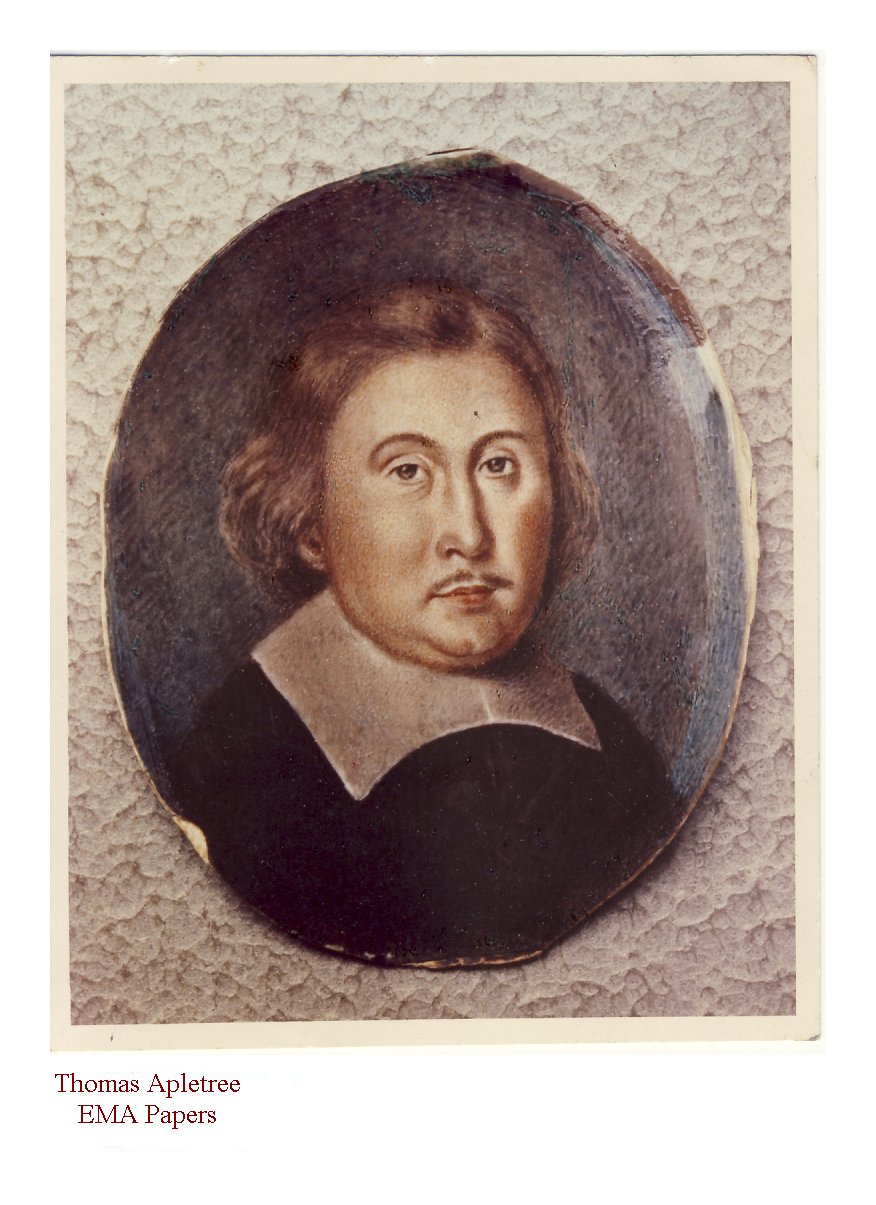
He was born in 1606 in Deddington to Thomas (b.1548) & Jane Warner. He had 5 siblings - Robert, John, James, Margaret & Elizabeth
In 1632 he married Jane Bustard of Adderbury. Jane died in 1641 and during the civil war years he remained single.
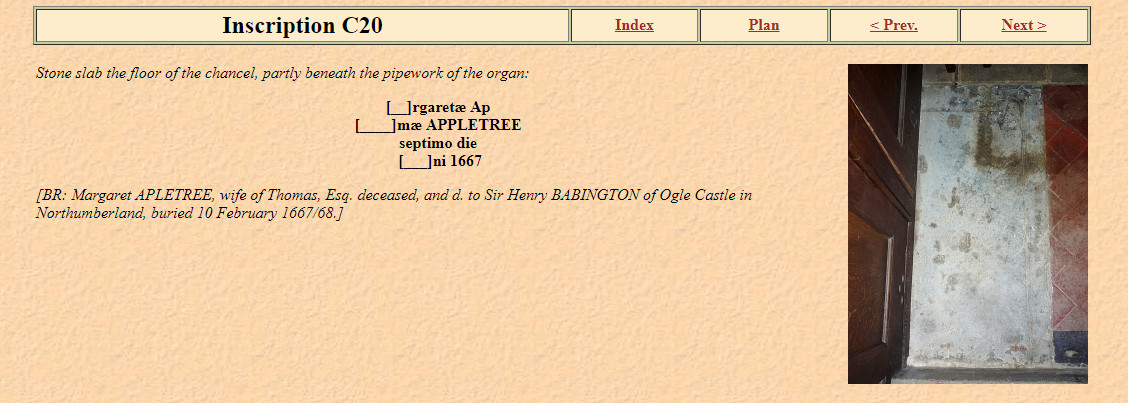
In 1648 he married Margaret Babington at 'St .Dunstan in the West' in London. She was the daughter of Sir Henry Babington of Ogle Castle Northumberland and related to Anthony Babington who was executed for his part in the plot to rescue Mary Queen of Scots.
Their children were Jane, George, Margaret, Lettice and Philip, all born in Deddington
He was an active member of the community and features in the town's 1623 tithing list, the 1641–42 recusancy returns, and the 1665 hearth tax returns.
He died on or about the 31 March 1666 and was buried on 2 April. Margaret died a year later in 1667 and was buried on 19 February
Reginald Apletree's book Chapter 5, page 61 et seq contains a very full account of his life and family.
Royalist or Parliamentarian?
It is recorded that after the battle at Cropredy Bridge in 1644 the royal army marched towards Adderbury whilst Charles made his way to Deddington. He spent the night at the parsonage (now known as Castle House)
Since 1548 the Apletree family had leased The Parsonage and its land from the Dean and Chapter of St George’s Chapel Windsor and at the time of the King’s visit the tenant was Thomas Apletree.
After the civil war this little known Deddington farmer was surprisingly rewarded by becoming a member of the Oxfordshire Committee for the Sequestration of Royalist Estates. He carried out his duties with a ruthlessness that earned him the description of being “a severe man, treating those that were of the King’s party in a very ill manner”. The Commonwealth authorities appreciated his severity for he was made a collector of the monthly contribution for the maintenance of the kingdom’s forces, a visitor to Oxford University and in 1654 he was required to carry out the ejection of scandalous and ignorant ministers and teachers in the county. He became a Justice of the Peace. He was “very strict and severe with the country people and would make them pay money for swearing and being drunk and used to have such people marked with the letters S and D in a red colour to signify that they were swearers and drunkards”. He carried out civil marriages as the Church was forbidden to conduct such services. And when Parliament decreed that the King’s palace of Woodstock and his manor at Holmby be pulled down, Thomas spent £1,500 on the purchase of stone and timber to build a balustraded tower extension to his house in Deddington.
However, even in 1646 there were doubts about Thomas’s allegiance. Articles of delinquency were brought to Oxfordshire Committee claiming that “Thomas Apletree....pretended himself to have good affection to the Parliament but underhand aided and assisted the King’s party....sending a great store of corn and other provisions into Oxford when it was a garrison for the King and went thither himself sundry times secretly to give information to the King’s party.....he feasted some of them and then drank a health in which he named confusion to Parliament......He was the chief means for the raising of twenty horse of war for the King.....and had given private intelligence to....embezzle and dispose of the goods of known delinquents whom he knew to have been in arms against the Parliament...so that they could not be seized or...sequestered by the State”
Thomas was cleared of any wrong doing, the committee receiving a petition from “many of the best affected gentlemen of the county expressing their grief that a gentleman so well affected to ye Parliament” should be thus accused. They and “divers Commanders in Chief...testified for his adventuring himself and his estate...to do real service giving intelligence from Oxford to ye Parliament forces.” The committee concluded that he “rather deserves encouragement for his good services than blame”
Five years later in 1651 another attempt was made to discredit Thomas. The Committee for Advance of Money sitting at Haberdashers Hall on behalf of Colonel Robert Lilburne heard that “ Thomas Apletree in the County of Oxon is a delinquent within the Acts and Ordinances of Sequestration for acting against Parliament and that he hath an estate in the said county in goods and lands to the value of £10,000 and upwards...... That the said Thomas Apletree a little before the last siege of Oxford....kept servants to lodge in a papists house....which...carried several carts loaded with wheat, bacon, pulse and other provisions by night into Oxford.....That the said Thomas in the years 1643, 1644 and 1645 held correspondence with the King’s party at Oxford and Banbury and had a protection under the King’s hand while he was Committee man for the Parliament”
[Editor's note: c.f. original documents dated May 1651 & 11 June & 19 June]
This time Colonel Purbeck Temple came forward with a character reference1. He testified that he did not know “any man that hath showed more affection to the Parliament or hath been more active in executing their commands during the War, that he had “constantly kept intelligence with the said Mr Apletree and upon occasions hath often received great assistance of horses from the said Mr Apletree which he did voluntarily contribute out of his affection to the Parliament Service during the time of the late Wars”
Was Thomas loyal to Parliament?2 Was he a spy for the Parliamentary cause or was he a double agent collaborating with the royalists and parliamentarians opportunistically? There is no doubt that he was very shrewd and successful in his civil war dealings, that he profited handsomely from the war and was a powerful figure in Oxfordshire during the Commonwealth. There is even a copy of a hymn he wrote in 1650 to celebrate Cromwell’s victory and occupation of Musselburgh. Long and rather unrhythmic, it was sung in John Goodwin’s church, St Stephen’s in Coleman Street in the City of London.
Thomas secured a pardon from the King in 1660 at the Restoration but at what cost is not known.
1 Colonel Purbeck Temple's statement also says he.....'had great reason to know his affection having many occasions to try him being Governor, by Commission from the Parliament, of Henley and Philis Court in the said County of Oxon'
2 This transcript of a letter dated 13 March 1653 that he wrote to The Protector, regarding money counterfeiters certainly indicates him currying favour
Rob Forsyth
BBC Making History
10 May 2011 Tom Holland in his programme Making History talks to Chris Day from Deddington and Ann Heymans (starting at 10' 52") about Thomas and his ability to remain in favour with both Royalists and Parliamentarians
Reconstruction of The Parsonage
In 1654 Thomas carried out extensive work on the building. He acquired the stone and timber by recycling materials from demolished Royalist palaces and country houses after the English Civil War. Because he was an active Parliamentarian, Appletree was appointed to the County Committee for the sequestration of Royalist property.His official role involved overseeing the dismantling of defeated Royalist estates, which gave him direct access to high-quality, salvaged materials. When Parliament decreed that the King's palace at Woodstock Manor be pulled down in 1651, Appletree was directly responsible for its demolition.He spent an estimated £1,500 to purchase its prime stone and timber to build the tower extension back in Deddington. He similarly acquired salvaged building materials from the pulling down of Holdenby House in Northamptonshire, which had been another massive Royalist estate seized by Parliament.
Link back to family page